

What Are the Different Types of Psychology Degrees?

Interested in a career that focuses on how the mind, brain and behavior work together? Earning a psychology degree may place you on the path to pursuing a variety of roles in the field. Professionals in this area observe, interpret and record individuals’ cognitive, emotional, and social skills. They focus their work on how humans interact with one another and their environments. And in turn, they provide their clients with the resources to cope more effectively with challenging life issues.
There are a few different levels of psychology degrees, from associate’s to doctoral degrees:
- Associate’s degree: This may fulfill requirements for jobs as a medical assistant or preschool teacher.
- Bachelor’s degree: Earning a bachelor’s in psychology can lead to potential opportunities to be a training specialist or market research analyst.
- Master’s degree: This may satisfy requirements for psychologist positions in settings including industrial organizations. A master’s can also prepare individuals for jobs as marriage and family therapists or applied behavior analysts, or it can be a step toward a doctoral degree, which some states require to become a licensed therapist. These educational requirements are a key factor when considering the difference between being a counselor or psychologist.
According to the U.S. Bureau of Labor Statistics (BLS), clinical and counseling psychologists typically need a doctoral degree to practice, either a Doctor of Philosophy (PhD) or a Doctor of Psychology (PsyD).ls or groups.
- Doctor of Philosophy (Phd): Designed for students looking to engage in research and produce new knowledge.
- Doctor of Psychology (PsyD): Focuses on the application of psychological science to provide a service to individuals or groups.
Types of Psychology Graduate Programs
The APA explains that professionals may pursue master’s degrees in psychology to receive more training and credentials to qualify for a doctoral program or to gain skills and knowledge for advancement in a specific career or organization—from marriage and family therapy to applied behavior analysis. Graduates with master’s degrees may find employment in a variety of sectors, including private business, government, education, and healthcare. They may pursue doctoral programs for greater depth of knowledge and to make new discoveries through scientific research.
It typically takes between 12 and 27 months to get a master’s degree in psychology, depending on your prior degree and the specific program requirements.
Pepperdine University Graduate School of Education and Psychology (GSEP) offers master’s degree programs that provide skills for graduates to be able to become licensed and work as marriage and family therapists, clinical psychologists, or applied behavior analysts. With a mission to prepare people to inspire change and enrich lives in their organizations and communities, Pepperdine’s online psychology graduate programs are available to students all over the world.
Learn about different psychology degrees to determine which type matches your professional goals.
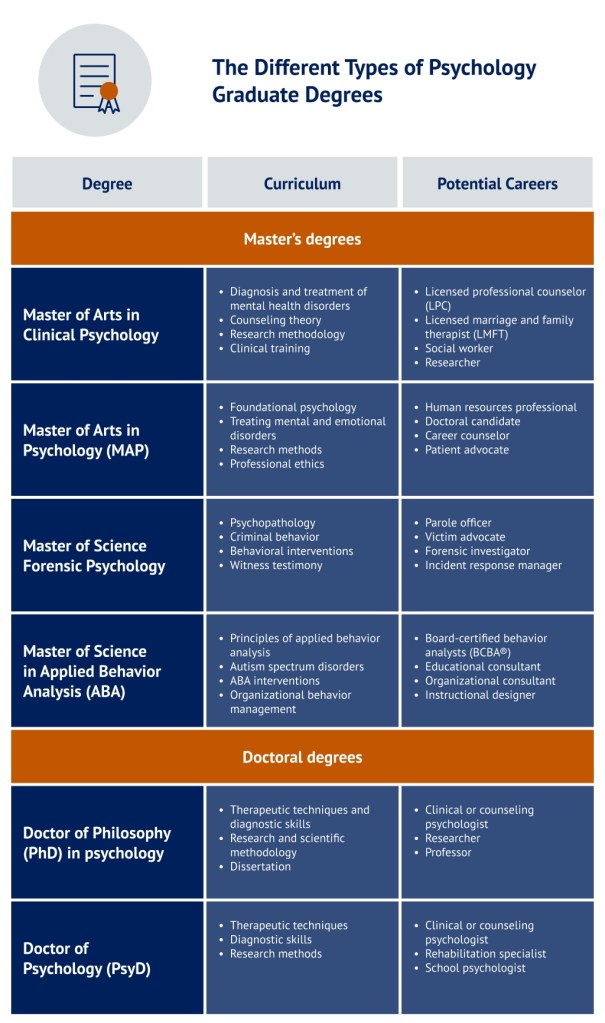
Master of Arts in Clinical Psychology (LPC or LMFT)
Clinical psychology programs may lead to a career as a licensed marriage and family therapist (LMFT) or licensed professional counselor (LPC).
What’s the difference between an LMFT and an LPC?
- A licensed professional counselor (LPC) provides mental health and substance abuse care to individuals, families, and groups.
- A licensed marriage and family therapist (LMFT) focuses on helping families and couples navigate issues affecting their relationships, mental health, and well-being. They provide proactive interventions like preventative couples therapy, while also observing how families and couples interact to guide individual and group counseling. To get a closer look at a day in the life of an MFT, start with our career overview: What Is a Marriage and Family Therapist (MFT)?.
Admission
MA in clinical psychology programs usually require a bachelor’s degree. In addition, transcripts, a minimum undergraduate GPA, GRE scores, letters of recommendation, personal statements, a résumé, and application fee may be required.
Curriculum and Focus
The curriculum for a clinical psychology master’s program may cover a variety of topics, including:
- Diagnosis and treatment of mental health disorders
- Multicultural counseling
- Theory of counseling and psychotherapy
- Trauma in diverse populations
- Research methodology
- Psychological assessment
- Intervention science
Students can expect to complete a practicum where a practicing clinical psychologist supervises their work in a clinical setting.
Program Outcomes
Graduates of clinical psychology MA programs may pursue a doctoral degree in clinical psychology. They can also become research coordinators or research assistants, building their credentials to enter a doctoral program. Those interested in employment options can use their knowledge of research methods, analysis and intervention techniques in workplace settings that involve counseling, behavioral research, or treatment development plans. In some states, MA clinical psychology graduates may apply for MFT licensure. Contact your state’s licensing board for more specifics.
As mentioned, Pepperdine offers online psychology graduate programs, including an MA in clinical psychology that offers paths to licensure for LPC or LMFT careers. The licensure paths available to students outside of California depend specifically on the program’s ability to operate within certain states.
Master of Arts in Psychology (MAP)
Master of Arts in Psychology programs may lead to doctoral study in psychology, a career in the field of human services, or professional advancement in a related field.
Admission
MAP programs typically require a bachelor’s degree. Other requirements may include transcripts, a minimum undergraduate GPA, GRE scores, letters of recommendation, personal statements, a résumé, and application fee.
Curriculum and Focus
Curriculum for MA in psychology programs may encompass topic areas such as:
- Research methods
- Data collection and analysis
- Core psychological concepts
- Mental and emotional disorders
- Professional ethics
- Scientific writing in psychology
Students may learn how psychological principles can be used to evaluate behavior, personality, and intelligence. Multiple electives may be offered, allowing a customized graduate program experience.
Which Psychology Master’s Is Right for You?
Program Outcomes
Professionals who have a MAP degree may use the breadth of knowledge that they acquired in graduate school in various settings. Their skills may be applied to high-level research, which can lead to doctoral degrees. Graduates who want to enter the workforce may find employment in areas such as behavioral counseling, human resources, advertising, and market research.
Pepperdine offers online psychology graduate programs, including an MA in psychology. You are not required to provide GRE scores to apply to an online psychology program from Pepperdine’s GSEP.
Master of Science in Applied Behavior Analysis (ABA)
Applied behavioral analysis (ABA) (PDF. 178 KB) is focused on assessing the environmental influences of behavior and applying evidence-based interventions to help improve patient outcomes.
Applied behavior analysis master’s programs may lead to careers involving the application of behavioral psychology. Students acquire skills to work with individuals diagnosed with impairments such as autism, developmental disabilities, or traumatic brain injury.
Admission
MS in ABA programs usually require a bachelor’s degree. In addition, transcripts, a minimum undergraduate GPA, GRE scores, letters of recommendation, personal statements, a résumé, and application fee may be required.
Curriculum and Focus
Students in MS in applied behavior analysis programs typically take courses in areas such as:
- Concepts and principles of applied behavior analysis
- Autism spectrum disorders, assessment procedures, and interventions
- Ethical and professional conduct
- Research methods
- Child psychopathology
Students usually are required to complete clinical training that helps them learn to observe and assess behavior patterns, identify target behaviors, consider evidence-based treatments, and determine strategies to promote positive changes.
Program Outcomes
Some MS in ABA programs help prepare graduates to sit for the Board Certified Behavior Analyst (BCBA®) exam. Graduates who become certified behavior analysts may seek employment in a sector of their choice—government, private industry, schools and colleges, hospitals, and mental health clinics, for example. They also may be qualified for a variety of roles, including behavior analyst, clinical director, educational consultant, instructional designer, and organizational consultant. Applied behavior analysts often provide assessment and intervention services to people with autism spectrum disorders.
Pepperdine offers online psychology graduate programs, including an MS in ABA designed for students who want to learn more about human behavior to help those in need.
Master of Science in Forensic Psychology
Master of Science in forensic psychology programs may open doors to careers that merge mental health and criminal justice.
Admission
MS programs in forensic psychology usually require a bachelor’s degree. In addition, transcripts, a minimum undergraduate GPA, letters of recommendation, personal statements, a résumé, and application fee may be required.
Curriculum and Focus
Master’s in forensic psychology programs typically will include coursework in:
- Criminal law
- Psychopathology
- Criminal behavior
- Behavioral interventions
- Research methods
- Witness testimony
Graduates are generally expected to complete supervised field work that provides them with hands-on training in a forensic setting where they may perform administrative tasks and make clinical observations.
Program Outcomes
An MS in forensic psychology may open the door to opportunities for people looking to begin a career or advance in the realms of law enforcement, corrections, mental health advocacy and administration, criminal analysis, victim advocacy, and policy analysis.
PhD in Psychology
Doctor of Philosophy (PhD) in psychology programs may prepare graduates to pursue careers in academia, where the emphasis is on engaging in research and producing new knowledge.
Admission
PhD in psychology programs, which often have areas of specialization, typically require a bachelor’s degree, and applicants may have a master’s degree. Professionals seeking PhDs in psychology usually have completed coursework in psychology and statistics and are able to show competence as researchers. In addition, transcripts, a statement of purpose, GRE scores, letters of recommendation, a résumé, writing samples, and an application fee may be required.
Curriculum and Focus
Professionals who earn a PhD in psychology may have a specialty area of graduate study. Specialities include:
- Clinical psychology
- Developmental psychology
- Quantitative psychology
They may be required to have teaching experience and will complete coursework on experimental procedures. A dissertation, internship experience, comprehensive written exam, or oral examination may be required before graduation.
Program Outcomes
While licensing laws vary by state, most clinical and counseling psychologists need a doctoral degree, according to the Bureau of Labor Statistics. PhD graduates might also pursue careers in academia as researchers or professors.
Doctor of Psychology (PsyD)
Doctor of Psychology (PsyD) programs may lead to careers that are focused more on administering psychological services rather than engaging in research.
Admission
Applicants to PsyD programs typically have a bachelor’s degree in psychology or another subject, with additional classes such as general psychology, psychopathology, statistics, research methods, and learning theory. In addition, transcripts, a statement of purpose, GRE scores, letters of recommendation, a résumé, writing samples, and an application fee may be required.
Curriculum and Focus
PsyD programs typically offer a curriculum that covers:
- Advanced psychotherapy and research methods
- Case studies
- Clinical training with supervision
Students are generally expected to complete a dissertation with guidance from faculty.
Program Outcomes
Professionals with PsyD degrees have a wide variety of career paths available to them. They may become a clinical or counseling psychologist and help identify and treat mental and behavioral disorders in a variety of settings. PsyD graduates can also pursue careers as psychotherapists, rehabilitation psychologists, and school psychologists.
Different Types of Psychology Fields
Psychology is an area of science that encompasses several specialties. While more ubiquitous areas include clinical psychology, applied behavioral analysis, and counseling, other types of psychology and their concentrations include:
Cognitive: Processes of thinking, remembering and learning.
Climate and environmental: Interaction of people with their environment.
Counseling: People’s development so they can be independent and thrive at all stages of life.
Developmental: Improving the lives of people with developmental challenges.
Experimental: Behavior of humans and animals.
Health: Improving people’s health and wellness using psychology.
Industrial and organizational: Behavior of people in organizations and at work.
Sports and performance: Improving psychological obstacles impeding athletic performance.
For professionals interested in pursuing a master’s degree in psychology, Pepperdine GSEP offers the following online graduate degree programs: MA in clinical psychology, MA in psychology and MS in applied behavior analysis.
The same master’s degree programs are available to those interested in earning a degree in person. Professionals who wish to further their education can consider Pepperdine GSEP’s Doctor of Psychology (PsyD) in Clinical Psychology program.
FAQs
-
There are a variety of career paths available to professionals with a master’s in psychology. With a Master of Arts in clinical psychology, you can pursue licensure to become a licensed professional counselor (LPC) or licensed marriage and family therapist (LMFT). A master’s in psychology can also be a good stepping stone toward pursuing a doctoral degree in psychology and a career as a psychologist.
With a master’s in psychology, professionals in various industries can improve their scientific reasoning, social responsibility, and critical thinking skills. HR professionals, victim advocates, and community health workers are just a few examples of careers where psychology expertise can be beneficial.
-
The cost of an online psychology degree at Pepperdine depends on the specific program and number of credit hours required. For the 2025–2026 academic year, the approximate cost for each program is:
– Online Master of Arts in Psychology: $97,440
– Online Master of Arts in Clinical Psychology: $138,040
– Online Master of Science in Applied Behavior Analysis: $60,900
For the most recent tuition and financial aid information, visit the Pepperdine Psychology Tuition and Financial Aid page.
Advance Your Career with a Psychology Degree
Last updated December 2025.