

Counselor vs. Psychologist: What’s the Difference?

Counselors and psychologists both play significant roles in mental health support systems across communities. However, they share a number of differences in education, qualifications and scope of practice. When deciding if you’re best suited to become a counselor or psychologist, it’s important to familiarize yourself with the skills and expertise required for each position.
What Is the Main Difference Between a Counselor and a Psychologist?
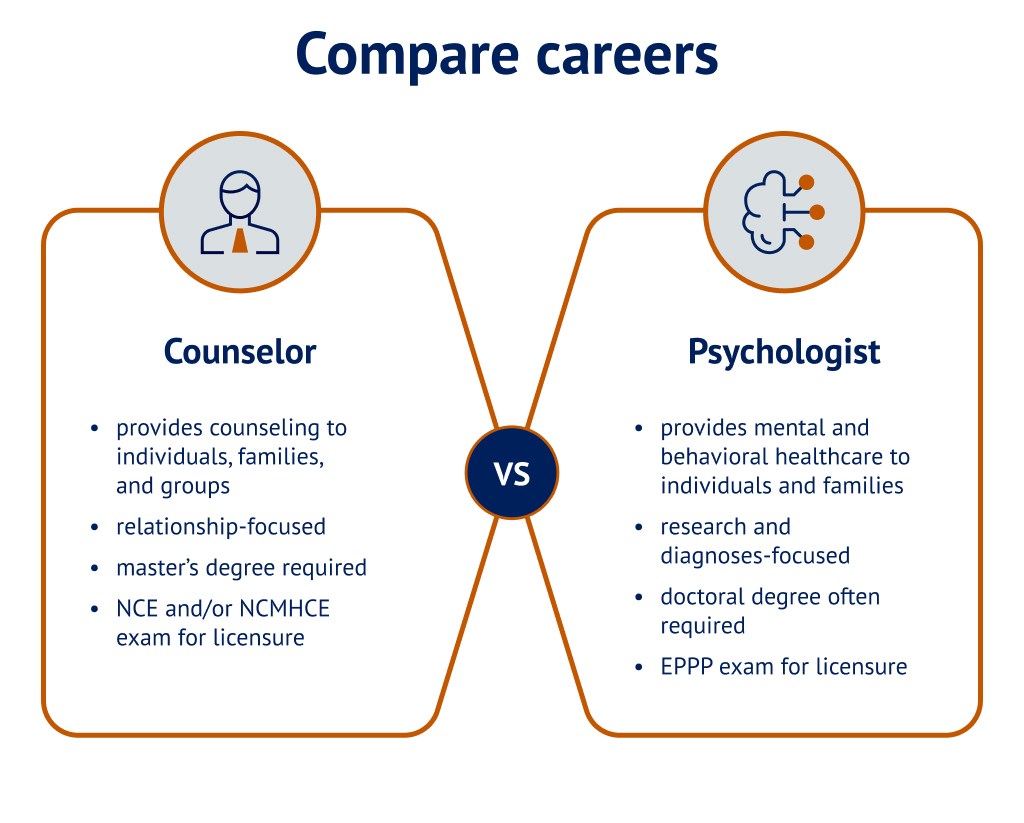
The difference between a counselor and a psychologist is rooted in how they approach mental healthcare. Counselors employ therapeutic techniques to help clients avert and cope with mental and emotional health challenges, according to the National Alliance on Mental Illness. They may also help individuals work through issues such as substance abuse, family and marital problems, stress management, self-esteem and aging.
Psychologists are often more research and diagnoses-focused. According to the Bureau of Labor Statistics (BLS), they assess, evaluate and treat emotional and behavioral disorders through psychotherapy and analysis.
What Is a Psychologist?
What is a psychologist and what does a psychologist do? A psychologist’s work is diversified across areas of research, psychotherapy, treatment, and diagnosis and testing.
Psychologists’ responsibilities often include:
- conducting scientific studies of behavior and brain function and observing clients
- identifying behavioral or emotional patterns or disorders that can better predict behavior
- discussing treatment with clients
- writing articles or research papers that educate others
A psychologist typically evaluates behavior through controlled laboratory experiments, psychoanalysis, or psychotherapy. When assessing patterns of behavior, they research and test theories using scientific methods. They also may administer tests based on personality, aptitude, or intelligence.
There are different types of psychologists, ranging from industrial-organizational to clinical to forensic psychologists. They treat short-term and long-term conditions, but they focus on how feelings, thoughts, and emotions influence behavior and are able to assess that through psychoanalysis.
What Is a Counselor?
Counselors focus more on building relationships with clients and helping create an equitable and inclusive environment.
Counselors’ responsibilities often include:
- evaluating clients’ mental and physical health, addiction, or behavior and creating treatment plans
- assisting clients in developing skills and behaviors to modify their behavior
- documenting and maintaining records of clients’ progress
- referring clients to resources such as job placement services and support groups
- conducting outreach programs to help people identify the signs of destructive behavior
A counselor treats the mental health of individuals or families, typically focusing on managing daily life stressors, crisis intervention, and relationship problems—which can often be addressed proactively through preventative couples therapy. They serve clients with mental health conditions such as anxiety, depression, grief, low self-esteem, stress, and suicidal ideation through talk therapy. They often are well-versed in multicultural and diversity issues as well as human development from early childhood to adulthood, sometimes specializing in certain populations.
Many mental health counselors work in inpatient or outpatient mental health and substance abuse centers, individual and family services, hospitals and government. While understanding human behavior is integral to the profession, counselors typically do not carry out diagnostic testing or psychoanalytical evaluations.
Education Requirements
The education requirements for each role are a strong differentiator between counselors and psychologists. Most clinical, counseling, and research psychologists require a minimum of a doctoral degree, which can take five to seven years to complete. Licensed professional counselors must have a master’s degree in counseling or school counseling, which can take two to three years of study.
Psychologist Education Requirements
What education is needed to become a psychologist? Generally, psychologists earn three degrees:
- A bachelor’s degree in psychology, or a similar field with significant coursework in psychology, is usually required for admission to a psychology master’s or doctoral program, according to the APA.
- A master’s degree in psychology can help you prepare for doctoral study. It is not always required for admission, depending on the program.
- A doctoral degree in psychology, such as a PhD or PsyD, is required in most states to achieve licensure.
A PhD is a research degree that generally requires a comprehensive exam, a one-year internship, and a written dissertation. A PsyD is a clinical degree. Some key competencies professionals can develop in either program include analytical, communication, interpersonal, and observational skills.
Students may also need laboratory experience in the classroom and research experience. Some programs may require an interview. It’s important to consider how to tailor your experience to fit psychologist education requirements for the graduate program.
Pepperdine Graduate School of Education and Psychology offers online psychology master’s degree programs as well as in-person psychology master’s programs. Both enable candidates to develop a deep understanding of human behavior and psychological principles while honing skills relevant for a psychology career.
Pepperdine GSEP offers an on-campus PsyD program to those looking to hone such competencies. The four-year program prepares candidates to become licensed psychologists through a rigorous curriculum that combines academics, clinical training, and research.
Counseling Education Requirements
According to the Council for Accreditation of Counseling and Related Educational Programs (CACREP), the master’s degree is considered the entry degree for practice as a professional counselor.
Graduate coursework may cover the following content areas:
- human growth and development theories in counseling
- social and cultural foundations in counseling
- helping relationships in counseling
- group counseling theories and processes
- career counseling and lifestyle development
- research and program evaluation
- professional orientation to counseling
Depending on the program, enrollment status, and state requirements, counselor education can take two to three years to complete. Some individuals then choose to pursue a doctoral degree in counseling.
Pepperdine Graduate School of Education and Psychology offers an online master’s in clinical psychology degree programs, preparing students for licensure as a licensed professional clinical counselor or a licensed marriage and family therapist.
Certification
Both counselors and psychologists require certification and/or licensure issued by state boards to practice their profession. The time and prerequisites to acquire a license varies, as each state has its own requirements.
Psychologist licensure in most states requires more education, some supervised experience, internship hours and an exam. Counselors generally need to complete a minimum of a master’s degree in counseling, internship hours, supervised counseling experience, and a national exam.
nd a passing score on a national exam.
Psychologist Licensure
To pursue psychologist licensure, you must:
- Meet the education requirements—typically a minimum of a doctoral degree in psychology from an accredited college or university program.
- Complete internship and postdoctoral hours according to your state’s requirements, usually at least 1,500 of each (PDF, 471 KB). When gathering information about your work experience, you should document the number of clients you worked with, the types of problems treated, proof of relevant coursework, and your professors’ names and degree titles.
- Pass the Examination for Professional Practice in Psychology (EPPP), which is administered by the Association of State and Provincial Psychology Boards (ASPPB). The EPPP is a multiple-choice test on the core areas of psychology with 225 questions. Although each state determines their passing scores for the EPPP, the minimum passing score for most states is 70% or 500 on the computer-based exams. The ASPPB recommends taking the EPPP as soon as you complete your degree. Some states may require a competency-based test or test of ethics, or a jurisprudence exam.
Specific requirements vary by jurisdiction, please consult with your state board for a full list of the current licensure requirements.
Find the Mental Health Career That Fits You
Counseling Licensure and Certification
Counselor certification is administered by the National Board for Certified Counselors (NBCC). The National Certified Counselor (NCC) certification may help you advance in your career. When you obtain board certification, it provides credibility to the public and employers that you have met the necessary standards and requirements for education, training, ethics, and experience. After you have completed your certification, you can work toward finding opportunities to grow in the counseling profession and continue your professional development.
According to the NCC, eligibility requirements to obtain certification include completing a master’s degree in counseling, accruing 3,000 hours of postgraduate counseling work and documenting 100 hours of postgraduate counseling supervision. You must also pass the National Counselor Examination (NCE) or the National Clinical Mental Health Counseling Examination (NCMHCE).
This is different from state licensure, which is legal permission from your state government to practice as a licensed counselor. To become a professional counselor, you will likely need to:
- Meet the education requirements, typically a master’s degree in counseling.
- Pass the licensure exam required in your state—the NCE and/or the NCMHCE.
- Obtain an initial license. This allows you to be supervised by a licensed independent practitioner in postgraduate practice and can be thought of as a temporary professional license. The name of the initial license will vary by state, but can include:
- associate licensed counselor
- licensed professional counselor candidate
- registered mental health counselor intern
- Complete clinical hours under the supervision of a licensed independent practitioner. Specific hour requirements vary by state.
- Complete additional state requirements and testing, such as a background check or ethics exam.
State licensure provides the following titles for individuals practicing independently:
- licensed professional counselor (LPC)
- licensed mental health counselor (LMHC)
- licensed clinical professional counselor (LCPC)
- licensed professional clinical counselor (LPCC)
Please note that this list is not exhaustive and may differ depending on state regulatory boards. Individual state requirements will vary and are subject to change, including LPC licensure standards, exam eligibility, and appropriate pathways, and may differ based on individual student backgrounds. Students should do their due diligence and determine the appropriate pathway and license type for themselves.
Job Duties and Scope of Practice
Another difference between counselor and psychologist is the scope of practice. Though the two professionals share some similarities like the populations they work with, counselors and psychologists carry out different tasks.
Counselors work holistically, approaching both general mental health and specific issues within mental health, such as addiction and substance abuse. They aim to improve overall mental wellness on a day-to-day basis by providing coping strategies.
Psychologists tend to be more specialized and treat a specific issue, such as an emotional or behavioral disorder, and work from a scientific perspective. They may collaborate with other healthcare or medical professionals, consulting them about research and findings.
Psychologist Job Duties and Scope of Practice
Psychologists communicate behavioral issues and help patients make decisions about their mental healthcare. Their scope of practice is multidisciplinary and focused on human interaction and mental health examinations. It also includes direct service delivery, enhancing communication with patients and observing behavioral change in terms of symptom or disease prevention. Psychologists provide mental and behavioral healthcare to individuals and families spanning various cultural, ethnic, and socioeconomic identities, according to the APA. When their clients are having trouble adjusting to intellectual, emotional, social, or behavioral issues, they help them work through the problems with behavioral assessments, diagnostic interviewing, administering psychologist tests, clinical services intervention, and emergency evaluation.
Other psychologist responsibilities may include consultation with other healthcare professionals. Together, they develop and perform services in health promotion, disease prevention, behavioral medicine, end-of-life care and care for patients with chronic conditions. In most states, a psychologist cannot prescribe medication. However, they can consult with psychiatrists and other medical professionals on treatment plans regarding medication.
Counseling Job Duties Scope of Practice
Counselors apply interventions and talk therapy techniques to help people work through their mental and emotional health experiences, including personal growth and adjustment to life stressors. Their scope of practice is rooted in holistic wellness counseling for improving mental health, but it is not clinical. They do not administer personality tests, IQ tests, or neuropsychological tests.
Counselors cannot prescribe medication to their clients. Counselors are trained in behavioral and emotional health, but they cannot assess or conduct testing on behavioral or mental health disorders.
Counselor responsibilities include listening to clients, developing treatment plans, and creating coping strategies to help manage daily life. Counselors are much more involved with day-to-day issues and helping clients shift their cognitive thinking to a healthier view. They often work with individuals as well as specific communities, examining issues such as bullying, anger management, depression, relationships, and self-image.
Counselor or Psychologist: Which Path is Right for You?
Deciding between a career as a professional counselor or a psychologist often comes down to your desired level of education and the specific clinical environment you envision for your future. To help you make an informed decision, this summary outlines the key differences in degree requirements, typical duration, and necessary clinical hours for each path.
| Requirement | Professional Counselor | Psychologist |
|---|---|---|
Minimum Degree | Master’s degree (MA or MS) | Doctoral degree (PhD or PsyD) |
Typical Duration | 2–3 years | 5–7 years |
Required Exams | NCE and/or NCMHCE | EPPP (and sometimes state ethics/jurisprudence exams) |
Clinical Hours | ~3,000 postgraduate hours (varies by state) | ~1,500 internship hours + ~1,500 postdoctoral hours (varies by state) |
Key Certifying Body | National Board for Certified Counselors (NBCC) | Association of State and Provincial Psychology Boards (ASPPB) |
Prescriptive Authority | No | No (except in a few states with additional training) |
FAQs
-
According to the BLS, the median annual wage for psychologists was $94,310 in 2024. Wages were highest, on average, for psychologists who worked for the government and ambulatory healthcare services. The median annual wage for substance abuse, behavioral disorder, and mental health counselors was $59,190 in 2024. On average, counselors who worked at hospitals earned the most.
-
In most states, psychologists cannot prescribe medications without a medical degree. Most psychologists have a doctoral degree in psychology, such as a PhD or a PsyD, which does not prepare them to have prescriptive authority. However, many psychologists work closely with psychiatrists to help create a comprehensive treatment plan for their clients that includes a combination of therapy and medication.
-
A licensed professional counselor (LPC) is trained to provide mental health and substance abuse care to individuals, families, and groups. They are licensed by the state they practice in to provide therapy and treatment to their clients.
Should You Become a Counselor or Psychologist?
When determining the weight and importance of counselor vs. psychologist, consider which profession works best for your skill set, expertise, educational qualifications, and professional experience. While counselors are focused on general therapy that may apply psychologists’ research, psychologists are more focused on evaluation within the field and they provide interventions for clients with specific disorders through diagnostic test administration, consultation with healthcare professionals and research.
Both have different educational requirements, but still focus on gaining professional work experience in the field that applies their education to real-life situations. The difference between counselor and psychologist lies in their unique approach to preserving and improving mental well-being. Ultimately, both share the same goal of helping people understand their behavior and emotions while strategizing to find practical solutions to promote emotional wellness.
Take the Next Step in Your Psychology Career
Last updated March 2026.