

10 Qualities of a Good Teacher: Skills for K-12
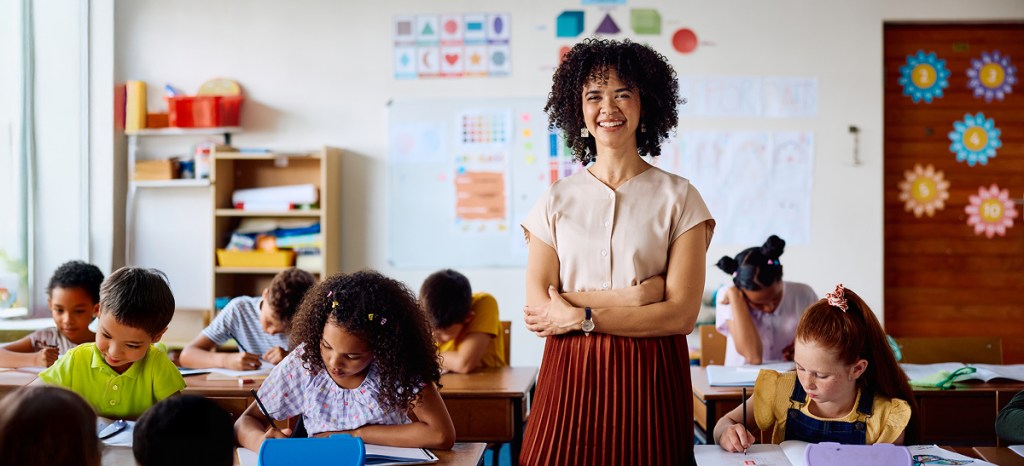
What separates a satisfactory teacher from an extraordinary one? Deep mastery of subject matter is a given, yet the most impactful educators seem to bring more to the table: nuanced soft skills that build genuine connection and trust.
According to the American Psychological Association, the quality of the teacher-student relationship remains a major predictor of social and academic achievement. Explore the ten essential skills to be a teacher who effectively leads modern classrooms.
Key Takeaways
- The human element is what keeps classrooms moving forward. Patience and adaptability help students feel safe enough to take risks and succeed.
- A commitment to lifelong learning and genuine cultural competence can keep you at the forefront of education. Programs like the online MA in Teaching can help you transition into advanced roles.
10 Essential Qualities of a Good K-12 Teacher
Qualities like patience and empathy are skills that excellent teachers develop alongside classroom management and pedagogical expertise. Focusing on these core areas can help you build a more purposeful environment for your students.
| Teacher Quality | Classroom Application | Value |
|---|---|---|
Patience | Extended wait times and iterative answer attempts | Normalizes learning mistakes and builds psychological safety |
Adaptability | Real-time instructional pivots and non-digital backup plans | Enhances student critical thinking and teacher self-efficacy |
Emphathy | Root-cause behavioral checks and private check-ins | Cuts suspension rates and helps students feel supported |
Communication | Step-by-step instructions and specific, timely feedback | Reduces cognitive load and boosts academic comprehension |
Cultural competence | Diverse text selection and inclusive classroom routines | Improves learning outcomes for marginalized students |
Continuous learning | Applying evidence-based research and seeking peer feedback | Signals professional credibility and keeps teaching modern |
Student engagement | Structured discussion protocols and problem-based tasks | Drives higher academic achievement and lowers dropout rates |
Organization | Consistent lesson procedures and visual agendas | Reduces job-related stress and maximizes instructional time |
Collaboration | Co-planning lessons and aligning with student support specialists | Prevents fragmented support and sharpens decision-making |
Stress management | Post-disruption reset routines and communication boundaries | Protects teacher energy and prevents career burnout |
Combine Theory With Practice in K-12 Classrooms
1. Patience
Patience in K-12 teaching is keeping your professional composure, even when student progress feels sluggish or non-linear. Edutopia calls this the “wisdom of going slow”: focusing on the learning objective rather than the timeline. It’s especially difficult for teachers under lots of pressure to cover more topics in less time and with fewer resources.
For students in a classroom that’s focused on urgency and efficiency, it can feel like a risk to speak up, read aloud, or ask questions. When teachers model patience, the whole classroom understands that these moments (and the mistakes that come with them) are necessary steps toward mastery.
In the classroom, patience looks like:
- Providing extended wait time after asking a complex question to allow for deeper processing
- Implementing re-teaching sessions for small groups without expressing frustration over the repetition
- Offering multiple answer attempts so students can revise their thinking and improve mastery without penalty
- Breaking larger tasks into manageable checkpoints rather than rushing to completion
These actions show you value student comprehension alongside the curriculum. You also help them practice consistency over intensity in their own workflows.
2. Adaptability
K-12 environments are unpredictable—student disruptions, changing schedules, and new mandates will affect your day-to-day plans. Then, half your class will be out with the flu. Adaptability lets you change direction without losing your way.
You can spot adaptability when teachers:
- Modify their instruction on the fly when they notice the majority of the class is struggling with a foundational concept
- Adjust pacing, questioning, and materials to keep all learners engaged rather than stuck behind a rigid plan
- Have a non-digital backup plan ready for moments when classroom technology fails
- Swap a whole-class explanation for targeted small-group support when formative checks show gaps, then bring the class back together once the concept lands
Adaptive instructional practices have been linked with greater opportunities for student critical and creative thinking, according to a 2019 edition of SpringerBriefs in Education. They also benefit teachers; adaptability can have positive effects on career optimism and self-efficacy in first-year teachers, according to a 2023 study in the Journal of School Psychology.
3. Empathy
If you want your lectures to feel more like genuine conversations with students, you need to understand and value their point-of-view. Demonstrating empathy in the classroom helps students feel heard, supported, and valued. Even brief interventions encouraging teacher empathy can cut suspension rates in half, according to a 2016 study in Proceedings of the National Academy of Sciences.
Empathy requires you to:
- Look beyond behavior to identify the underlying cause of their struggle
- Validate a student’s frustration with a difficult concept or listen closely to their concerns regarding a social conflict
- Ask reflective questions that help students articulate what happened and how to repair harm
- Check in privately with a disengaged student to invite their perspective on what feels challenging
A good place to start is recognizing that your students bring their whole lives into the classroom. You can offer a moment of grace before assigning consequences, or simply pause to ask what’s happening beneath the surface.
4. Communication
Teachers who articulate expectations well and provide purposeful feedback tend to see higher levels of comprehension and academic success, according to 2023 research on effective communication in learning. Clarity reduces the cognitive load on students; they can focus on mastering new material rather than decoding vague instructions.
In a K-12 setting, strong communication involves:
- Paraphrasing a student’s answer to confirm their line of thinking
- Adjusting your vocabulary the moment you spot confusion
- Proactive outreach to parents to create a supportive partnership
- Giving clear, step-by-step instructions before independent work, then checking for understanding before students begin
- Delivering specific, timely feedback that tells students exactly what to improve and how to improve it
5. Cultural Competence
Students bring different traditions and lived experiences into the classroom each day. Culturally responsive teaching (CRT) has been shown to improve learning, particularly for those with historically marginalized backgrounds.
A teacher can:
- Select texts that represent multiple cultures
- Integrate real-world examples that connect to students’ communities
- Invite students to share perspectives shaped by their backgrounds
- Use inclusive classroom routines, like learning correct name pronunciation and encouraging multilingual expression when appropriate
Cultural competence also requires ongoing self-reflection. Effective teachers constantly examine their own assumptions, adapt communication styles when needed, and establish norms that honor differences.
6. Continuous Learning Mindset
Teachers who engage in continuous learning recognize that changing students’ needs, best practices, and technologies require study. The Learning Policy Institute’s 2017 review of 35 rigorous studies found that effective professional development (PD) is content-focused, job-embedded, and sustained over time. This means teachers improve the same way their students do: through long-term repetition and deliberate practice.
While continuous learning often pertains to formal professional training, it also shows up in practical habits like:
- Testing a new formative assessment routine and refining the next lesson accordingly
- Joining a professional learning community
- Seeking feedback through peer observation
- Learning a new tool to improve instruction
- Reading current education research and applying one evidence-based strategy at a time
- Pursuing an advanced degree, like an online MA in Teaching, to translate daily classroom experience into leadership
The drive to learn is a characteristic of a teacher who signals credibility because they’re doing what they ask of students: iterating and getting better on purpose.
7. Student Engagement
Student engagement, defined as the behavioral, emotional, and cognitive involvement in learning, is strongly associated with higher academic achievement and lower dropout rates, according to a 2024 meta analysis in the Journal of Educational Psychology. Students who are actively engaged persist through difficulty and retain more of what they learn.
Teachers who have mastered this tend to design lessons that encourage participation rather than passive listening. This might include:
- Using structured discussion protocols where every student must contribute
- Embedding think-pair-share moments before calling on volunteers
- Incorporating problem-based learning tasks that require collaboration and decision-making
- Formative checks, such as quick polls or exit tickets
- Rotating student-led roles, such as discussion facilitator or summarizer, so learners take ownership of the lesson
- Using retrieval practice strategies, like low-stakes quizzes or quick recap prompts
Intrinsic motivation spikes when learners experience relevance and personal connection, a fundamental premise of the self-determination theory. When students can see how content connects to their lives or goals, they’re more likely to internalize the value of the work and engage more deeply.
8. Organization and Time Management
In a 2024 survey, teachers reported significantly more frequent job-related stress compared to similar working adults. Organization helps teachers navigate those stresses while maintaining professional health and instructional quality.
In the classroom, organization could look like:
- Structured routines that reduce friction and maximize learning time
- Posting daily objectives and using consistent lesson formats
- Setting procedures for transitions, submissions, and make-up work
- Using a visual agenda so students can track the flow of the lesson
- Establishing a consistent system for distributing and collecting materials
Organization and time management are not fixed strengths and most teachers are building systems while teaching full time and meeting reporting requirements. These skills are often coping strategies in a role with competing demands, limited time, and constant interruptions.
9. Collaboration
Collaboration allows educators to coordinate support and respond more effectively to students whose needs extend beyond a single subject or period. In practice, collaboration often begins before instruction does.
A teacher with this skill is adept at:
- Aligning with specialists on accommodations
- Comparing formative data with a grade-level team
- Consulting a counselor when patterns of behavior suggest something deeper
- Coordinating with another teacher to reinforce expectations and routines across shared student groups
- Co-planning a lesson or unit with colleagues to strengthen differentiation and share resources
These conversations sharpen decisions and prevent fragmented support. When professionals communicate well, students benefit from consistency instead of mixed messages.
10. Stress Management and Resilience
Stress management and resilience sit in the same vein as organization and time management. They’re not “nice-to-have” characteristics of a teacher, but skills that make the job sustainable. In a role with constant emotional labor and limited recovery, resilience helps a teacher keep showing up with steadiness and care.
In the classroom, resilience can look like:
- Using a consistent reset routine after a disruption, so you don’t carry frustration into the next period
- Setting clear boundaries for communication, such as defined email hours, to protect planning time and personal recovery
- Reflective habits like noting what worked after a hard lesson and identifying one adjustment to try next time
- Seeking support early, instead of waiting until small challenges become unmanageable
Remember, burnout does not arrive all at once; it accumulates. Stress management is how teachers protect their energy, their students, and their longevity in the profession.
Ready to Elevate Your Teaching Career?
Exceptional educators don’t simply rely on instinct to manage complex classroom dynamics or lead school-wide initiatives. Instead, they treat leadership as a professional discipline that requires rigorous academic and personal development.
Pepperdine University offers a purposeful online experience rooted in a heritage of academic excellence. To find your ideal path, consider our guide comparing an MSE vs. MAT vs. EdD to help align your graduate studies with your professional vision.
The online MA in teaching online program from the Pepperdine University Graduate School of Education and Psychology prepares you to become a leader in the classroom and in your community.
Learn more about the program today, or reach out to us for more information.
Created by the online MA in teaching program from the Pepperdine University Graduate School of Education and Psychology.